
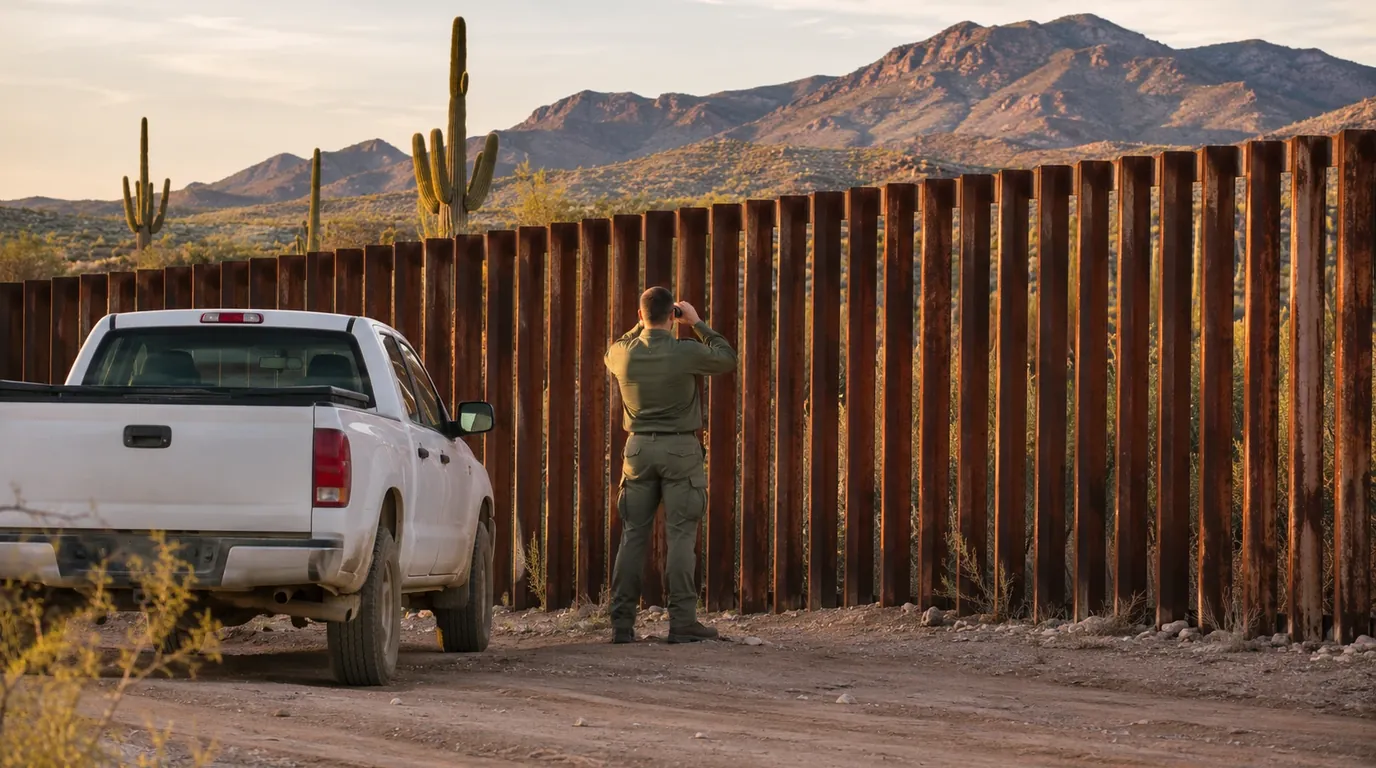
A new Border Patrol agent hired at GL-5 earns $51,632 to $58,979 a year in 2026 on the pay tables, depending on the duty station, and $64,540 to $73,724 once the 25% overtime supplement most agents work is added. At GS-12, the grade agents can reach after about four years, pay with the supplement is $114,981 to $131,344 at step 1 and up to $170,751 at step 10 in San Diego. These are the Office of Personnel Management’s 2026 law enforcement special rate tables, in force since January 11, 2026, which cover Border Patrol agents (series 1896) and pay them 3.8% more than in 2025.
The key figures
Annual pay in 2026, step 1 unless stated, from OPM’s special rate tables for covered law enforcement personnel. “With Level 1” adds the 25% supplement for 2 hours of scheduled overtime a day.
| Grade | Rest of US table | Rest of US with Level 1 | Laredo with Level 1 | Tucson-Nogales with Level 1 | San Diego with Level 1 |
|---|---|---|---|---|---|
| GL-5 | $51,632 | $64,540 | $67,040 | $65,763 | $73,724 |
| GL-7 | $58,771 | $73,464 | $76,310 | $74,856 | $83,919 |
| GL-9 | $65,545 | $81,931 | $85,105 | $83,485 | $93,591 |
| GS-11 | $76,745 | $95,931 | $99,648 | $97,750 | $109,584 |
| GS-12 | $91,985 | $114,981 | $119,435 | $117,160 | $131,344 |
| GS-12, step 10 | $119,583 | $149,479 | $155,269 | $152,311 | $170,751 |
The tables are L046 (Rest of US), L031 (Laredo), L056 (Tucson-Nogales) and L050 (San Diego). El Paso, Del Rio, the Rio Grande Valley and Yuma aren’t named locality areas, so stations there use the Rest of US table. CBP’s current hiring announcement on USAJOBS quotes the same range: $51,632 to $124,717, where the top figure is GS-11, step 10 with the 25% overtime included.
| Comparison | Median pay | Source |
|---|---|---|
| Police and sheriff’s patrol officers, all employers | $76,210 | BLS OEWS, May 2025 |
| Police and sheriff’s patrol officers, local government | $75,780 | BLS OEWS, May 2025 |
| All US occupations | $50,980 | BLS OEWS, May 2025 |
Why the pay is higher than most salary sites say
Pay sites built on the regular General Schedule miss two things. First, Border Patrol agents haven’t been paid on that table since January 11, 2026. OPM’s memo CPM 2025-25 put “GS-1896 Border Patrol Agents” in Customs and Border Protection on new special rate tables that pay 3.8% more than 2025, against 1% for most federal staff, and confirms they apply to GL grades too. Agents at GL-5 to GL-9 were already on higher law enforcement base rates, so a GL-5 in the Rest of US area gets $51,632 rather than $40,736 on the regular table.
Second, the overtime is built in. Aggregator averages like $65,000 mostly reflect table pay, so they leave out the supplement that turns a $91,985 GS-12 into a $114,981 one.
How Border Patrol overtime works
The Border Patrol Agent Pay Reform Act sets three schedules (5 U.S.C. 5550):
- Level 1: 8 regular hours plus 2 hours of scheduled overtime each workday, paid as 1.25 times your hourly rate. A 10-hour day becomes a 100-hour pay period (the two-week periods and paydays are on our federal pay calendar).
- Level 2: 1 hour of scheduled overtime a day, paid as 1.125 times your rate.
- Basic: no scheduled overtime, the table rate only.
Each year you choose a level 30 days before the year starts, and if you don’t choose, you’re put on Level 1. The law lets CBP keep the share of agents on Level 2 or the basic rate at each location to 10%, so Level 1 is the normal pattern. Hours beyond 100 in a pay period earn regular overtime pay or time off on top. Agents CBP decides can’t work the daily overtime go on the basic rate, and so do agents working at headquarters, as instructors or in admin posts, so ask what applies at the academy and in any office posting.
Two details matter for your money. The supplement isn’t counted when overtime, night, Sunday and holiday pay are worked out. But it counts as basic pay for your pension, life insurance and severance, so the extra 25% builds your retirement as well as your pay cheque.
How you move from GL-5 to GS-12
CBP hires at GL-5, GL-7, GL-9 or GS-11, depending on your experience and education, with promotion potential to GS-12, the full-performance grade. A bachelor’s degree in any field qualifies you for GL-5; a degree with superior academic achievement (a 3.0 GPA, for example) or a year of law enforcement or similar experience can get you GL-7. Promotions aren’t automatic: you need at least a year at each grade before the next one (OPM’s time-in-grade rule), so a GL-5 hire reaches GS-12 after four years at the earliest.
Your step rises over time too. Within GS-12 in the Rest of US area, step 10 pays $119,583 on the table and about $149,479 with Level 1, which is $34,498 more than step 1.
The hiring bonuses
The current announcement (open November 1 to 30, 2026) offers new agents:
- $10,000 when you complete the Border Patrol Academy in Artesia, New Mexico (about six months);
- another $10,000 if you accept a prioritized station: Sierra Blanca, Presidio, Sanderson, Comstock, Freer and Hebbronville in Texas, Lordsburg in New Mexico, or Ajo in Arizona;
- up to $30,000 more in retention incentives spread over your first three years.
That’s up to $50,000 on top of salary. Bonuses are taxed as wages, and the terms change between announcements, so read the one you apply under. New hires may also first spend up to a year on the D.C. task force, according to the same announcement.
What an agent takes home
Our calculation for a single filer at 2026 rates, with the standard deduction, Level 1 pay, and the 4.9% FERS pension contribution that law enforcement officers hired from 2014 pay:
| Agent | Pay with Level 1 | Federal income tax | Social Security and Medicare | State income tax | FERS (4.9%) | Take-home a year | A month |
|---|---|---|---|---|---|---|---|
| GL-5, step 1, El Paso, Texas | $64,540 | $5,565 | $4,937 | none | $3,162 | $50,875 | $4,240 |
| GS-12, step 1, Tucson, Arizona | $117,160 | $16,945 | $8,963 | $2,535 | $5,741 | $82,976 | $6,915 |
| GS-12, step 1, San Diego, California | $131,344 | $20,257 | $10,048 | $7,826 | $6,436 | $86,778 | $7,231 |
Federal employees don’t pay California’s state disability insurance, so it isn’t in the San Diego line. Health and life insurance and Thrift Savings Plan savings come out too, and depend on your choices. The San Diego agent earns $14,184 more than the one in Tucson but keeps only $3,802 more, because California’s income tax is higher and San Diego’s prices are too: check how far each salary goes with the salary comparison by city.
The pension
Border Patrol agents retire under the law enforcement rules of FERS: an immediate pension at 50 with 20 years of service or at any age after 25 years, worth 1.7% of your highest three-year average pay for each of the first 20 years and 1% a year after that, and retirement is compulsory at 57 (5 U.S.C. 8412(d), 8415(e) and 8425(b)). An agent who retires after 20 years with a high-three of $149,479 (GS-12, step 10 in the Rest of US area, with Level 1) gets 34% of it, about $50,823 a year, before cost-of-living increases and the separate FERS supplement. To estimate your own, with your service and retirement age, use our FERS retirement calculator.
2027: a freeze for most federal staff, 3.8% for law enforcement
The President’s alternative pay plan of August 26, 2026 keeps General Schedule pay at 2026 rates for 2027, but tells OPM to raise law enforcement pay by 3.8% (House Document 119-189). OPM chooses which jobs that covers and publishes the tables, which it did on December 31 for 2026. If Border Patrol agents are covered again, a GS-12, step 1 in the Rest of US area would get about $95,480 on the table, or roughly $119,350 with Level 1. Our GS pay scale page follows the 2027 tables when they come out.
CBP officer or Border Patrol agent?
People often search “CBP officer salary” for the same job, but CBP officers (series 1895) work at ports of entry such as airports and land crossings, not between them. They’re on the same 2026 law enforcement tables and a GS-5 to GS-12 ladder, but their overtime comes from a different law, so it varies with the port and the shifts rather than being a fixed 25%.
Check your own numbers
- How a federal agent’s pay compares: our post on how much FBI agents make covers the other big law enforcement pay rule, LEAP.
- The US pay hub shows pay by state and city across our careers.
- Already in law enforcement? See where your pay sits against the official figures for your job.
- Comparing federal security jobs? TSA officers are paid on TSA’s own pay bands rather than the law enforcement tables; their salary page has the official figures by state and city.
Limits of these figures
These are 2026 table rates; your pay depends on your grade, step and the duty station on your SF-50, and on the overtime level you work. The take-home figures are our own calculation for one person with no other income (methodology). The bonus terms come from one USAJOBS announcement and change between announcements. BLS doesn’t publish a separate figure for Border Patrol agents, so the comparison uses police officers.
Sources
- U.S. Office of Personnel Management, CPM 2025-25, 2026 Special Rates for Certain Law Enforcement Personnel, December 31, 2025, and the 2026 special rate tables L046 Rest of US, L031 Laredo, L056 Tucson-Nogales and L050 San Diego, effective January 11, 2026.
- U.S. Customs and Border Protection, Border Patrol Agent announcement BPA DH 27-2 on USAJOBS, open November 1 to 30, 2026 (grades, pay range, incentives, academy, duty stations).
- 5 U.S.C. 5550 (border patrol rates of pay), 8412(d), 8415(e), 8422 and 8425(b) (FERS law enforcement retirement and contributions); 5 CFR 300.604 (time in grade).
- The White House, Alternative Plan for Pay Adjustments, August 26, 2026 (House Document 119-189).
- U.S. Bureau of Labor Statistics, Occupational Employment and Wage Statistics, May 2025: police and sheriff’s patrol officers (SOC 33-3051) by ownership, and all occupations.
- IRS 2026 federal income tax brackets and standard deduction, the 2026 Social Security wage base, and Arizona and California 2026 income tax rates, as used in our take-home calculator.