

A Canadian resume is short, plain and built around results. The Government of Canada’s Job Bank asks for no more than two pages, your name, address, email and phone number at the top, and no photo, no age, height or marital status and never your Social Insurance Number. You write it without “I”, “my” or “me”, show what you achieved with numbers rather than listing duties, keep each section to no more than 5 to 7 bullet points, and put references on a separate sheet that you send only when an employer asks for it.
Below is a free Word template built to those rules, what to leave out and why, and what has changed for job seekers in Ontario and British Columbia, where job ads now have to show the pay.
Free Canadian resume template
Download the Canadian resume template (Word, .docx). It opens in Word, Google Docs, Pages and LibreOffice. It is one Letter-size page with every section below, plus a separate references sheet. Replace each item in [brackets]; the grey notes tell you what goes where.
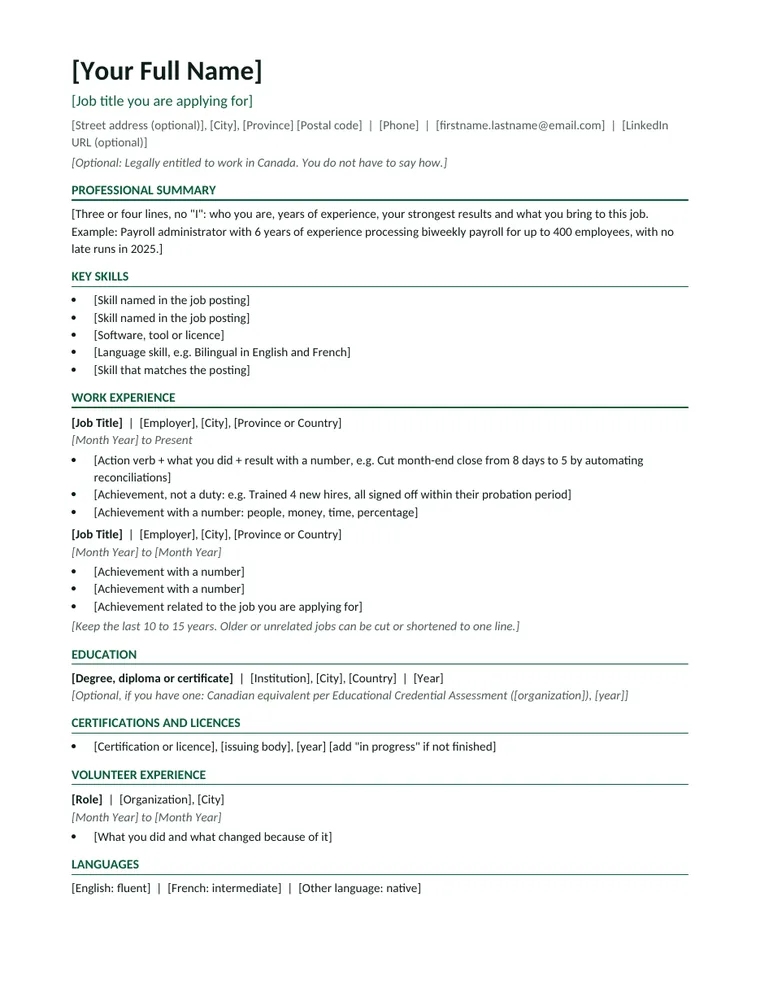
The Canadian resume format at a glance
| Section | What goes in it | Rule behind it |
|---|---|---|
| Contact details | Name, address, phone, an email based on your name | Job Bank: top of the first page; no nicknames or numbers in the email |
| Professional summary | Three or four lines on what you offer this employer | Job Bank: clear and concise, tailored to the position |
| Key skills | The skills the posting asks for that you can prove | Job Bank: no more than 5 to 7 bullets a section |
| Work experience | Most recent first, achievements with numbers | Job Bank: highlight achievements, use firm numbers and action verbs |
| Education | Credential, school, country, year | Add the Canadian equivalent if you have an assessment (see below) |
| Certifications and licences | Anything the job requires | Professional licensing can still be required |
| Volunteer work | Unpaid roles, written like jobs | Job Bank: include it under work or volunteer experience |
| Languages | English, French and others, with your level | Useful for bilingual roles |
| References | On a separate sheet, sent only when asked | Job Bank |
Two pages is the ceiling, not the target. Job Bank says an employer takes an average of 30 seconds to skim a resume, and suggests cutting or shortening experience that is more than 15 years old.
What to leave out of a Canadian resume
Things that are normal on a CV in some countries can hurt you in Canada, because they invite exactly the questions employers are not allowed to ask.
| Leave out | Why |
|---|---|
| A photo | Job Bank: “not the norm in Canada”. The Ontario Human Rights Commission says employers should not ask for one |
| Date of birth or age | Job Bank lists it as a detail to leave out; in Ontario an application form may only ask if you are 18 or over |
| Marital status, children, height, weight | Job Bank; Ontario allows no questions on marital or family status when you apply |
| Social Insurance Number | Job Bank: “Never include your Social Insurance Number”. Canada.ca: it is only needed after you are hired |
| Place of birth, nationality, immigration status | An Ontario form may ask only whether you are legally entitled to work in Canada |
| ”I”, “my”, “me” | Job Bank: write in the third person |
| Reasons for leaving a job | Job Bank: keep the resume entirely positive |
| Hobbies | Job Bank: only if they relate to the job |
If you want to answer the work question up front, one line is enough: “Legally entitled to work in Canada.” You do not have to say whether you are a citizen, a permanent resident or on a work permit. The template has this line as an option under your contact details.
Duties versus achievements: three rewrites
Job Bank’s advice is to show what you achieved, with numbers an employer understands. Some examples of the difference (illustrations, not real people):
| Instead of a duty | Write the result |
|---|---|
| Responsible for payroll | Ran biweekly payroll for 400 employees with no late payments in 2025 |
| Handled customer complaints | Resolved about 30 customer complaints a week and cut repeat calls by a quarter |
| Trained new staff | Trained 4 new hires, all signed off within their probation period |
Start each bullet with an action verb (“handled”, “managed”, “led”, “developed”, “increased” are Job Bank’s examples), then say what changed because of your work.
If you are new to Canada
- Translate your credentials. An Educational Credential Assessment (ECA) checks whether a foreign degree, diploma or certificate is valid and equal to a Canadian one. Immigration, Refugees and Citizenship Canada designates five organizations to issue them, including World Education Services and the International Credential Assessment Service of Canada. If you already have one from your immigration application, add the Canadian equivalent under your education.
- Explain your employers. A Canadian recruiter may not know your previous company. Half a line on what it does and how big it is (“one of Kenya’s largest logistics firms, 2,000 staff”) helps them place your experience.
- “Canadian experience” can no longer be a requirement in Ontario job ads. Since 1 January 2026, Ontario employers with 25 or more employees cannot require Canadian experience in a public job posting or its application form. Professional licensing and registration requirements still apply.
- Spell out your languages. If you speak French, say so, with your level: many federal and Quebec-facing roles ask for it.
For a full picture of moving here from Britain, including pay and tax, see our guide to moving to Canada from the UK.
Read the job posting before you write
Two provinces now make employers put more in the ad, and it changes how you tailor your resume.
| Province | Since | What a public job posting must show |
|---|---|---|
| Ontario | 1 January 2026 (employers with 25+ employees) | Expected pay or a range no wider than $50,000 a year (unless the job pays over $200,000); whether AI is used to screen, assess or select applicants; whether there is an existing vacancy; no “Canadian experience” requirement |
| British Columbia | 1 November 2023 (all employers) | The expected wage or salary, or a range with both ends stated (“up to $30 per hour” does not meet the rule) |
What to do with that:
- Match the posting’s words. If the ad says AI is used to screen applicants, use the same terms for your skills and job titles as the posting does, so the match is easy to see.
- Check the pay against official data. Our Canada salary pages use Job Bank’s own wage data by province, for example electricians in Canada. If a posted range sits well below the median for the job, you know before you apply.
- Expect an answer in Ontario. Since January, an Ontario employer covered by the rules has to tell applicants it interviewed whether a decision has been made within 45 days. Why that silence happened so often before is in why recruiters ghost you after the final interview.
Your resume is not the place for salary expectations; keep them for the application form or the interview, and use the posted range as your starting point.
Fill in the template in six steps
- Start from the posting. Highlight the skills and requirements it names; those become your key skills.
- Write the work experience first. For each job, three to five achievement bullets, newest job first.
- Write the summary last. Three or four lines that pull your strongest results for this job.
- Cut to fit. Two pages at most, no more than 5 to 7 bullets a section, older or unrelated roles shortened.
- Check the details. No spelling mistakes (Job Bank suggests having someone else read it), a professional email, and none of the personal details listed above.
- Save as PDF for most applications, unless the employer asks for Word, so the layout stays the same.
The limits of this guide
- Rules differ by province and employer. Human rights codes are provincial for most employers; federally regulated employers (banks, airlines, telecoms) fall under the Canadian Human Rights Act. The Ontario form rules quoted here come from the Ontario Human Rights Commission.
- Quebec works mainly in French, and many employers there will expect a French resume.
- Some fields have their own conventions. Academic, medical and research jobs often use a longer CV, and federal government jobs are applied for through their own forms.
- Job Bank’s advice is guidance, not law. The posting rules for Ontario and British Columbia are law.
Looking for work? You can also put your profile on Paygrade’s talent board so employers can find you.
Sources
- Job Bank (Government of Canada), How to write a good resume, modified 30 May 2024.
- Government of Canada, Protecting your Social Insurance Number, checked 11 November 2026.
- Ontario Human Rights Commission, Designing application forms (Policy on human rights at all stages of employment, section IV-4).
- Government of Ontario, Requirements related to publicly advertised job postings (Your guide to the Employment Standards Act), updated 24 February 2026.
- Government of British Columbia, Pay Transparency Act: guidance on wage or salary information on job postings.
- Immigration, Refugees and Citizenship Canada, Educational Credential Assessment, modified 16 October 2026.