
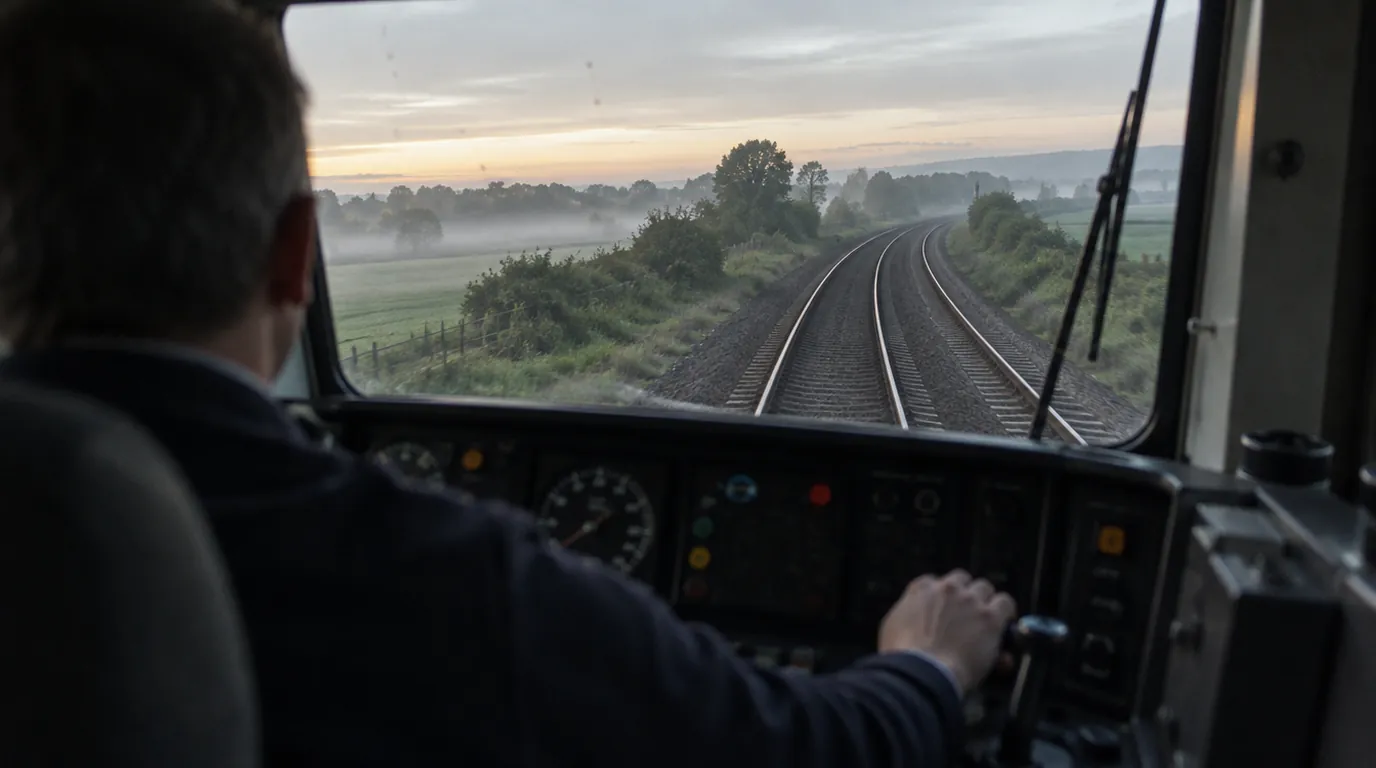
You can now become a train driver in Great Britain at 18. The legal minimum age for a train driving licence fell from 20 to 18 on 30 June 2026, and there is no degree requirement. You apply to a train company as a trainee (or a level 3 apprentice), pass its selection process and the regulated psychological and medical exams, then train for roughly 12 to 18 months on full pay. The government puts trainee pay at £27,000 to £33,000, and the median full-time train driver earned £74,376 in the year to April 2026 (ONS ASHE 2026, provisional).
Key figures
| What | Figure | Source |
|---|---|---|
| Minimum age to hold a licence | 18 (20 in the Channel Tunnel zone) | Train Driving Licences and Certificates (Amendment) Regulations 2026, in force 30 June 2026 |
| Who licenses drivers | Office of Rail and Road (ORR) | Regulated professions register |
| Typical training | 12 to 18 months (apprenticeship route) | Train driver apprenticeship, standard ST0645 |
| Trainee pay | £27,000 to £33,000 a year | Department for Transport, 19 August 2026 |
| Median pay, full-time train and tram drivers | £74,376 a year | ONS ASHE 2026 (provisional), Table 14.7a |
| Middle half of drivers earn | £67,374 to £82,880 | ONS ASHE 2026 |
| Take-home on the median | about £53,695 a year (£4,475 a month) | Our calculation, 2026/27 tax rates |
| Drivers reaching retirement age by 2030 | a quarter | Department for Transport, 10 February 2026 |
Can you become a train driver at 18?
Yes, since 30 June 2026. The rules sit in the Train Driving Licences and Certificates Regulations 2010, and the 2026 amendment (S.I. 2026/461, made on 27 April 2026) changed the minimum age for a licence from 20 to 18. Two exceptions: nobody under 20 may drive a train in the Channel Tunnel zone, and the amendment does not extend to Northern Ireland.
Young people could already drive Tube trains and trams from 18, as the Department for Transport pointed out when it announced the change in February 2026. Many guides online still say 20 or 21, and job adverts posted before June may too, so check the current rule with the train company.
What you need to apply
- No degree and no legal minimum qualification. Apprentices do have to reach at least level 2 in English, maths and ICT before their final assessment, under the apprenticeship standard, which is why many operators ask for GCSEs in English and maths or equivalent.
- A psychological and a medical exam. The Office of Rail and Road regulates train driving and keeps the licence register. Before a licence is issued, you pass an occupational psychological fitness exam with an ORR-recognised psychologist and a medical with an ORR-recognised doctor. The medical standards, including eyesight and hearing, are set in the regulations, and qualified drivers have periodic medicals after that.
- A licence and a certificate. The licence (free, and applied for by your employer) shows you are fit and competent to drive on the mainline. Your employer also issues a certificate for the routes and types of train you drive, so moving company or route means more training.
How you get in: trainee jobs and apprenticeships
Each train company recruits its own trainee drivers, through its careers website, and each runs its own tests and interviews before the regulated exams. Freight operators recruit too. The Department for Transport points applicants to The Train Drivers Academy, an industry site with guidance on applications and trainee vacancies.
The training itself is the same whether the job is called trainee driver or apprentice: classroom learning on rules, traction and safety, then hours of supervised driving and route learning. Under the level 3 apprenticeship it typically takes 12 to 18 months, and the final assessment has three parts: an online test on safety, security and driving, an observed drive covering planned, degraded and emergency working, and a professional discussion with an independent assessor. You need your licence and certificate before that assessment.
What train drivers earn
ONS counts about 20,000 full-time train and tram driver jobs. Their pay in the year to April 2026:
| Point in the pay range | Full-time train and tram drivers | All full-time employees |
|---|---|---|
| Lowest 10% earn under | £52,135 | £25,288 |
| Lowest 25% earn under | £67,374 | £30,600 |
| Median | £74,376 | £40,911 |
| Average (mean) | £74,751 | £52,109 |
| Highest 25% earn over | £82,880 | £56,842 |
The median train driver earns about 82% more than the median full-time employee, and roughly twice the £37,730 median for transport and machine drivers as a whole (the wider occupation group that includes lorry, bus and van drivers). The pay range is unusually tight: even the lowest-paid tenth of drivers earn more than the UK median. That fits a job where most pay is set by negotiated scales for each company rather than by individual bargaining.
The median is 2.6% lower than ONS’s figure for 2025. ASHE estimates for an occupation of this size move around from year to year, so read that as roughly flat rather than a fall.
By region, ONS publishes a median only where its sample is big enough: £74,670 in London, £75,388 in the South East and £73,851 in the East of England, all close to the national figure. For London’s wider pay picture, see our average salary in London page, and for other careers, salaries in the United Kingdom.
Trainee pay is lower while you learn: the Department for Transport puts national trainee salaries at £27,000 to £33,000. Pay then rises in steps after you qualify, on the company’s own scale, which is why the bottom of the ASHE range for qualified drivers sits around £52,000.
Take-home pay
| Gross a year | Take-home a year | A month |
|---|---|---|
| £27,000 (trainee, low end) | £22,960 | £1,913 |
| £33,000 (trainee, high end) | £27,280 | £2,273 |
| £52,135 (lowest 10% of drivers) | £40,796 | £3,400 |
| £74,376 (median driver) | £53,695 | £4,475 |
| £82,880 (highest 25% start) | £58,628 | £4,886 |
After income tax and National Insurance at 2026/27 rates for England, Wales and Northern Ireland, standard tax code, before pension contributions and any student loan. In Scotland the median leaves about £51,658. Work out your own with our salary calculator.
Why are train drivers paid so much?
- Strong collective bargaining. Drivers’ pay is negotiated company by company with the union ASLEF. The last big settlement, after a two-year dispute, gave drivers at 16 companies rises of 5% for 2022/23, 4.75% for 2023/24 and 4.5% for 2024/25 (Railway Magazine, 18 September 2024), and 96.58% of those voting accepted it (Railnews).
- A shortage that is getting worse. A quarter of train drivers reach retirement age by 2030, 32% in Scotland and the North East and 38% in Wales, and fewer than 4% of drivers are under 30, according to the Department for Transport. Only 11% are women. Lowering the age to 18 is meant to widen the pool. Pay tends to stay high wherever too few people can or will do a job, as with the highest-paying job nobody wants.
- Long, paid training and a licensed job. Companies pay trainees for a year or more before they drive alone, and a driver’s certificate is tied to that company’s routes and trains, so experienced drivers are costly to replace.
The same logic runs through other well-paid jobs that need no degree, from air traffic control to the work in our list of the highest-paying jobs without a degree.
How UK train drivers compare abroad
| Country | Official occupation | Median pay | Times the national median |
|---|---|---|---|
| United Kingdom | Train and tram drivers | £74,376 | 1.8 (full-time employees) |
| United States | Locomotive engineers | $81,410 | 1.6 (all jobs) |
| United States | Subway and streetcar operators | $86,380 | 1.7 (all jobs) |
| Canada | Railway and yard locomotive engineers | C$104,000 | |
| Australia | Train and tram drivers | A$156,052 |
Sources: ONS ASHE 2026 (full-time); BLS OEWS May 2025 (all jobs, national median $50,980); Job Bank 2025 (median hourly wage x 2,080 hours); Jobs and Skills Australia from ABS May 2025 (full-time non-managerial median weekly earnings x 52). Each country measures pay differently, so compare the “times the national median” column, not the raw amounts. Australian train drivers stand out, which is worth knowing if you are weighing up moving to Australia from the UK.
What to do next
- Check the basics: you must be 18 or over and able to pass the medical, including eyesight and hearing standards.
- Watch the train companies near you. Trainee driver vacancies open at different times for each company and fill fast, so set up alerts on their careers pages and The Train Drivers Academy.
- Look at apprenticeships and freight operators as well as passenger trainee jobs.
- Be ready to move depot. Vacancies are advertised for named depots, and your certificate covers the routes from that depot.
- Prepare for the tests: the selection process includes psychometric testing before the ORR’s psychological exam, and practice helps.
Limits of the data
ASHE is a sample survey of employers’ payroll records; the occupation also includes tram and Tube drivers, and figures for 2026 are provisional until ONS revises them next year. Annual pay is gross, including overtime and shift pay, for employees in the same job for at least a year. The trainee range is the Department for Transport’s national figure; each company sets its own. More in our methodology.
Sources
- Office for National Statistics, Annual Survey of Hours and Earnings 2026 (provisional), Table 14.7a (occupation, SOC 2020 code 8231) and Table 15 (region by occupation), released 22 October 2026.
- The Train Driving Licences and Certificates (Amendment) Regulations 2026, S.I. 2026/461, made 27 April 2026, in force 30 June 2026 (legislation.gov.uk).
- Department for Transport, “Doors opened for school leavers to become train drivers”, 10 February 2026, and “Just got your GCSE results? Your next stop could be the train driver’s seat”, 19 August 2026 (GOV.UK).
- Office of Rail and Road, train driver entry on the UK regulated professions register.
- Institute for Apprenticeships and Technical Education (now Skills England), Train driver end-point assessment plan, ST0645, 2018.
- Railway Magazine (PA), 18 September 2024, and Railnews, 18 September 2024, on the 2024 driver pay settlement.
- U.S. Bureau of Labor Statistics, OEWS May 2025; Government of Canada Job Bank, wages 2025; Jobs and Skills Australia, occupation data February 2026.