
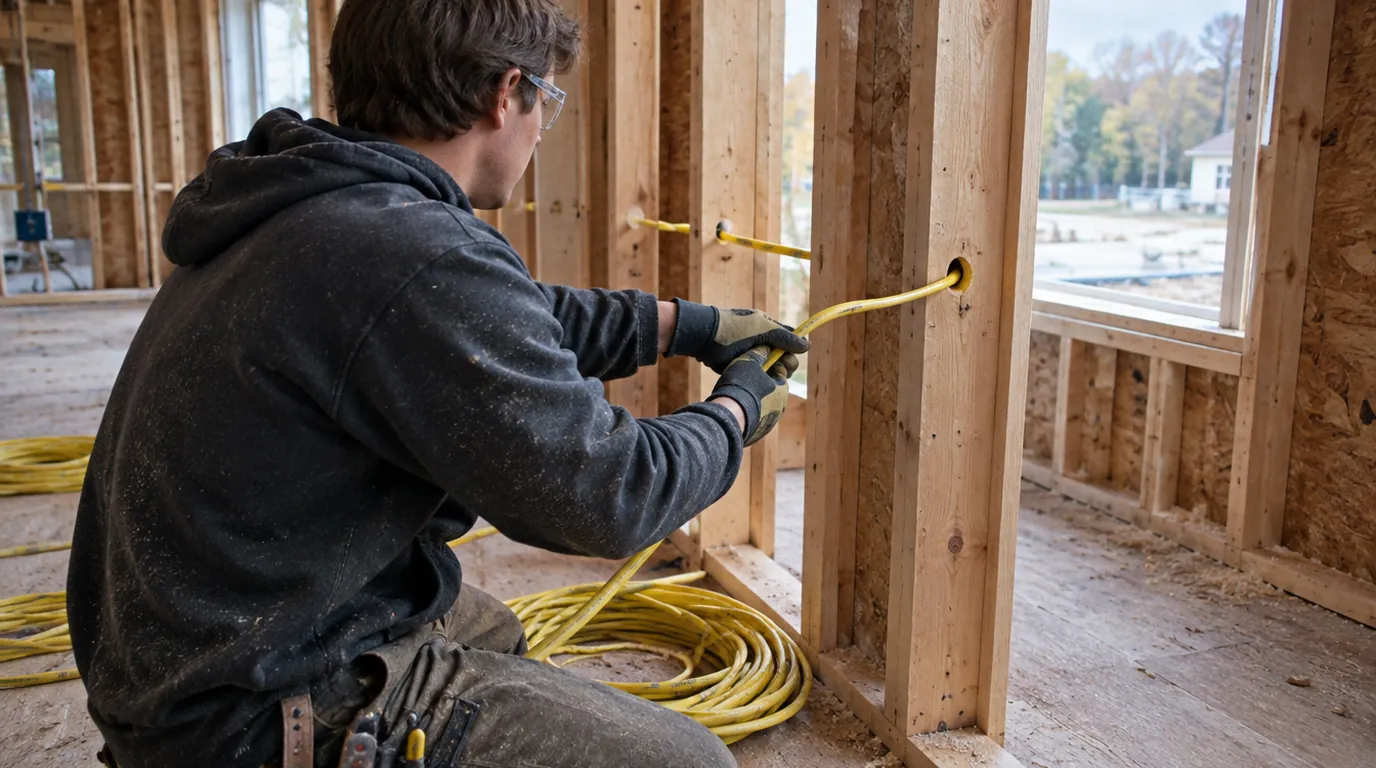
To become an electrician in Ontario, you register as an apprentice in trade 309A (Electrician, Construction and Maintenance) with Skilled Trades Ontario, complete 9,000 hours of training with a sponsoring employer or union (7,950 hours on the job and 1,050 hours across four levels of school), then pass the Certificate of Qualification exam with at least 70%. It takes about five years. 309A is a compulsory trade, so you can’t do electrical work for pay without being a registered apprentice or a certified electrician. Once certified, electricians in Ontario earn a median of $34.00 an hour, about $70,700 a year (Job Bank, November 2025).
A lot of the guides you’ll find still quote 840 hours of school and tell you to register with the Ontario College of Trades. Both are out of date: Skilled Trades Ontario took over in 2022, and the new four-level curriculum finishes rolling out in September 2026. Every figure below is checked against the official sources listed at the end.
The key figures
| What | Figure | Source |
|---|---|---|
| Total apprenticeship | 9,000 hours, about 5 years | Skilled Trades Ontario, June 2026 |
| On the job | 7,950 hours | Skilled Trades Ontario |
| In school | 1,050 hours over 4 levels | Skilled Trades Ontario |
| Minimum education | Grade 10 | Skilled Trades Ontario |
| Final exam | Red Seal, 90 to 150 multiple-choice questions, 4 hours, pass mark 70% | Skilled Trades Ontario exam guide, June 2026 |
| Exam fee | First attempt free for apprentices who finish in Ontario, then $150 + HST | Skilled Trades Ontario |
| Electrician pay, Ontario | $20.00 low, $34.00 median, $50.50 high an hour | Job Bank, updated 19 Nov 2025 |
| Ontario minimum wage | $17.95 an hour since 1 Oct 2026 | Government of Ontario |
All pay figures are gross (before tax) in Canadian dollars. Annual figures assume a 40-hour week, 52 weeks a year.
309A, 309C or 442A: which electrician trade is yours?
Ontario has three main electrician apprenticeships, and they aren’t interchangeable:
| Trade | Code | Compulsory? | Red Seal? | Entry | Levels | In school | On the job | Total |
|---|---|---|---|---|---|---|---|---|
| Construction and Maintenance | 309A | Yes | Yes | Grade 10 | 4 | 1,050 h | 7,950 h | 9,000 h |
| Domestic and Rural | 309C | Yes | No | Grade 10 | 3 | 810 h | 6,390 h | 7,200 h |
| Industrial | 442A | No | Yes | Grade 12 | 4 | 1,050 h | 7,950 h | 9,000 h |
Source: Skilled Trades Ontario, Apprenticeship Programs Quick Facts Chart, updated June 2026.
When people say “electrician” they almost always mean 309A: wiring and maintaining homes, offices, shops and construction sites. 309C is narrower and 1,800 hours shorter, but it has no Red Seal, so the certificate travels less well outside Ontario. 442A (industrial) works in plants and factories and is voluntary, which means certification isn’t legally required for the work, though many employers still ask for it. If you’re not sure, 309A keeps the most doors open.
Step by step: how to become a licensed electrician in Ontario
1. Check you can start
Skilled Trades Ontario’s basic requirements are simple: you must be at least 16, legally allowed to work in Canada, meet the trade’s education standard (Grade 10 for 309A) and have a sponsor in Ontario. In practice, many employers and college programs prefer Grade 12 with math, because the in-school levels lean heavily on calculations and the Canadian Electrical Code.
2. Get ready (optional, but it helps you get hired)
You don’t need any course to start an apprenticeship, but an empty CV is the hardest thing to sell to a contractor. Two common ways in:
- Pre-apprenticeship programs. These are government-funded, last up to a year, and can include Level 1 apprenticeship schooling and academic upgrading. Ask Employment Ontario what’s running near you.
- The Ontario Youth Apprenticeship Program (OYAP). If you’re still in high school, OYAP and dual-credit programs let you start building trade experience before you graduate. Your guidance counsellor can set it up.
A college electrical techniques diploma is a third route. It costs more and takes longer, but some contractors like the head start it gives.
3. Find a sponsor
Your sponsor is the employer, group of employers or union that takes responsibility for your training. This is the step that stops most people, because nothing happens until someone agrees to take you on. Where to look:
- Licensed electrical contractors in your area (residential, commercial and industrial all train apprentices).
- Union training programs. IBEW locals across Ontario run apprenticeship intakes for construction electricians.
- College career centres, Employment Ontario and job sites. Search “309A apprentice” rather than just “apprentice electrician”.
- People you know in the trades. A lot of first apprenticeships still come through a referral.
4. Apply and sign your training agreement
Once a sponsor agrees, you apply through Skilled Trades Ontario. If you’re 18 or over you can apply online through the Skilled Trades Ontario Portal, which is the fastest route; under-18s use a paper form signed by a parent or guardian. When it’s approved, you and your sponsor sign a training agreement and register it with Skilled Trades Ontario. You’ll get a registered apprentice wallet card to carry on site, and because 309A is compulsory, your name goes on the public register.
5. Log 7,950 hours on the job and finish four levels of school
Most of your apprenticeship is paid work under a licensed electrician, with your skills signed off in a logbook. Every so often you leave the job site for a block of in-school training at a college or union training centre.
The school part changed in the last few years. Under the new electrical curriculum, Levels 1 to 3 are a common core shared by all electrical trades, and Level 4 (240 hours) is specific to 309A. Level 3 is now 270 hours. The new Levels 3 and 4 start on 1 September 2026.
6. Write the Certificate of Qualification exam
When your training agreement is complete, Skilled Trades Ontario issues a Provisional Certificate of Qualification, valid for one year, so you can keep working while you prepare. Then you write the exam:
- Because 309A is a Red Seal trade, you write the Red Seal exam.
- It’s multiple choice, between 90 and 150 questions, with a 4-hour limit.
- The pass mark is 70%.
- Your first attempt is free if you completed your apprenticeship in Ontario. After that it’s $150 + HST per attempt, and you must wait 30 days before a retake.
Pass, and you’re a certified 309A electrician with the Red Seal endorsement, the interprovincial standard that makes it much easier to work in other provinces and territories.
How long does it take?
| Stage | Typical time |
|---|---|
| Pre-apprenticeship or college (optional) | Up to 1 year |
| Finding a sponsor | Weeks to months, depending on your area and experience |
| Apprenticeship (9,000 hours) | About 5 years |
| Exam | Within the 1-year life of your provisional certificate |
The apprenticeship is hours-based, not time-based. Work fewer hours (a slow season, a layoff) and it takes longer; steady full-time work with plenty of overtime can bring it in a little sooner, but you still have to complete all four school levels.
How much do apprentice electricians make in Ontario?
Apprentices are paid while they learn, but well below a certified electrician. Your exact rate is set by your training agreement, or by the collective agreement if you’re in a union, and it normally rises as a percentage of a journeyperson’s wage as you clock hours and pass levels. Whatever the agreement says, you can never be paid less than Ontario’s minimum wage: $17.95 an hour since 1 October 2026.
Here’s what common percentage steps work out to against the Ontario median for certified electricians ($34.00 an hour). Your own percentages will be in your agreement; these are worked examples, not legal rates.
| Share of a $34.00 journeyperson rate | Hourly | What you’d actually be paid | A year (40 h a week) |
|---|---|---|---|
| 40% | $13.60 | $17.95 (minimum wage applies) | $37,336 |
| 50% | $17.00 | $17.95 (minimum wage applies) | $37,336 |
| 60% | $20.40 | $20.40 | $42,432 |
| 70% | $23.80 | $23.80 | $49,504 |
| 80% | $27.20 | $27.20 | $56,576 |
| Certified (100%) | $34.00 | $34.00 | $70,720 |
The takeaway: if your agreement starts at 40% or 50% of a typical journeyperson rate, the minimum wage is what you’ll really earn in your first period. Pay starts to move once you’re past the halfway percentages, and in this example the biggest single jump comes when you’re certified. Rates vary a lot between employers, so compare a few offers before you sign. Job Bank files apprentices under the same occupation code as certified electricians, and puts the low end of the Ontario range at $20.00 an hour, which is a realistic early-apprenticeship benchmark.
What licensed electricians earn in Ontario, region by region
Once you’re certified, where you work matters almost as much as how long you’ve worked:
| Region | Median hourly | Median a year | Low to high hourly |
|---|---|---|---|
| Ottawa | $38.45 | $79,976 | $24.22 to $50.22 |
| Northwest | $36.82 | $76,586 | $23.10 to $55.21 |
| Kitchener-Waterloo-Barrie | $36.00 | $74,880 | $20.00 to $52.00 |
| Windsor-Sarnia | $35.00 | $72,800 | $20.00 to $54.70 |
| Toronto | $34.86 | $72,509 | $20.62 to $51.40 |
| Muskoka-Kawarthas | $34.80 | $72,384 | $22.00 to $46.75 |
| Ontario | $34.00 | $70,720 | $20.00 to $50.50 |
| Stratford-Bruce Peninsula | $32.50 | $67,600 | $20.00 to $44.50 |
| Hamilton-Niagara Peninsula | $32.00 | $66,560 | $20.00 to $50.00 |
| Northeast | $31.00 | $64,480 | $19.00 to $52.00 |
| London | $29.75 | $61,880 | $18.50 to $49.37 |
Source: Job Bank, Electrician (NOC 72200), Ontario, updated 19 November 2025. Toronto, Ottawa and Northwest use Statistics Canada’s small-area estimates; other regions use the Labour Force Survey, 2023 to 2024. Annual figures are our conversion at 2,080 hours.
Two things stand out. Ottawa pays the most, with a median more than $8 an hour above London. And Toronto, despite its living costs, sits less than $1 an hour above the provincial median.
How does that compare beyond Ontario? Canada’s national median for electricians is $35.00 an hour (C$72,800 a year, Job Bank). In US dollars that is about $52,000 at current exchange rates, which puts Canada in the lower half of the 12 countries we track for electrician pay, well behind Switzerland and the United States (most other countries’ figures are Paygrade estimates: how we model pay). See the full comparison in our electrician salary in Canada breakdown and the electrician salary by country table.
What it costs, and what’s now free
| Cost | Amount | Notes |
|---|---|---|
| Pre-apprenticeship program | Government-funded | Ask Employment Ontario what’s running near you |
| Level 1 classroom fee | Free for classes starting from 1 Jan 2026 | Ontario now pays the $10-a-day fee for Level 1 |
| Later levels | Check with your college or training centre | The province’s fee change covers Level 1 only; ask your union or employer whether they cover later levels |
| Tools | Varies | Most employers expect apprentices to build a basic hand-tool kit |
| Certificate of Qualification exam | First attempt free for Ontario completers, then $150 + HST | 30-day wait between attempts |
| Canada Apprentice Loan | Up to $4,000 interest-free per period of technical training | For Red Seal trades like 309A |
One thing that has gone: the federal Apprenticeship Incentive Grant and Apprenticeship Completion Grant both closed on 31 March 2025. Plenty of older guides still list them, so don’t budget on that money.
Compared with a university degree, the money runs the other way: you’re paid for almost all of the 9,000 hours. That’s a big part of why licensed electricians feature in our guide to the highest-paying jobs without a degree.
After the C of Q: master electrician and contractor licences
Your Certificate of Qualification lets you work as an electrician. It doesn’t let you run your own electrical business. In Ontario that’s regulated separately by the Electrical Safety Authority (ESA):
- No one can operate an electrical contracting business without an electrical contractor licence ($448 a year from 1 April 2026).
- Every contractor must designate at least one licensed master electrician to supervise the work. The master electrician exam costs $164 and the licence $91 a year.
This is the route for electricians who want to go out on their own and run their own jobs.
Is it worth it?
For most people who like hands-on, problem-solving work, yes: no tuition debt, a paycheque from the first week, a trade that can’t be outsourced, and a certified median of about $70,700 a year in Ontario with room to earn well above that. The costs are time and patience: five years, four blocks of school and a real exam at the end.
If you’re weighing it up:
- See the full picture of the career, including pros, cons and the skills employers want, on our electrician career profile.
- Already an apprentice or newly certified? Check where your pay sits with the salary calculator for electricians in Canada, or take the Am I Underpaid? quiz.
- Comparing provinces or a move to Canada? Our Canada salaries hub covers every career we track.
- Curious about the specialist end of the trade? Read why elevator technicians are paid so much.
- Still choosing a trade? See how electricians compare with all 54 Red Seal trades in the highest paying trades in Canada.
Limits of this guide
Training hours, curriculum and fees come from Skilled Trades Ontario and the Ontario government as of October 2026, and they do change; check the Skilled Trades Ontario site before you apply. Wage figures are Job Bank estimates from survey data (2023 to 2024), not job offers, and they don’t include overtime or benefits. The apprentice pay table is a worked example: your real rate is whatever your training agreement or collective agreement sets. This guide is general information, not career or legal advice. How we handle salary data is explained on our methodology page.
FAQ
Can I become an electrician in Ontario without an apprenticeship? Not for 309A work, because it’s a compulsory trade. Experienced workers trained elsewhere can apply to Skilled Trades Ontario for a trade equivalency assessment, which can make them eligible to write the exam without completing an Ontario apprenticeship.
Can I keep working while I wait to write the exam? Yes. When you finish your apprenticeship you get a provisional Certificate of Qualification, valid for one year, which lets you keep working in the trade while you prepare.
Is the 309A exam hard? It’s a serious exam: up to 150 multiple-choice questions in 4 hours, with a 70% pass mark and heavy use of the Canadian Electrical Code. Skilled Trades Ontario publishes sample questions and an exam preparation guide, and if you fail you can retake it after 30 days.
Sources
- Skilled Trades Ontario, Apprenticeship Programs Quick Facts Chart, updated June 2026 (hours, levels, entry requirements for 309A, 309C and 442A).
- Skilled Trades Ontario, Starting your apprenticeship, Finishing an apprenticeship and Exam Preparation Guide, June 2026 (application, provisional certificate, exam format, fees, pass mark).
- Skilled Trades Ontario, Exam scheduling (“there is a mandatory 30-day waiting period before you can retake it”).
- Job Bank, Government of Canada, Electrician (NOC 72200) wages in Ontario, updated 19 November 2025 (median, low and high hourly wages, provincial, regional and national).
- Government of Ontario, Minimum wage ($17.95 an hour from 1 October 2026).
- Ministry of Labour, Immigration, Training and Skills Development, In-Class Enhancement Fund: Level 1 classroom fees, November 2025.
- Skilled Trades Ontario, Electrician, Construction and Maintenance trade information (9,000 hours, approximately five years; the older 840-hour in-school split; new Levels 3 and 4 from 1 September 2026) and Electrical Trades Apprenticeship Curriculum Standard, December 2023 (Levels 1 to 3 at 270 hours each, 309A Level 4 at 240 hours).
- Skilled Trades Ontario, Transition from the Ontario College of Trades to Skilled Trades Ontario, January 2022.
- Government of Ontario, Pre-apprenticeship training (free programs of up to 52 weeks).
- Government of Canada, Canada Apprentice Loan and Apprenticeship grants (loan amounts; grants closed 31 March 2025).
- Electrical Safety Authority, 2026 licensing fees, effective 1 April 2026, and O. Reg. 570/05 (contractor and master electrician licences).