
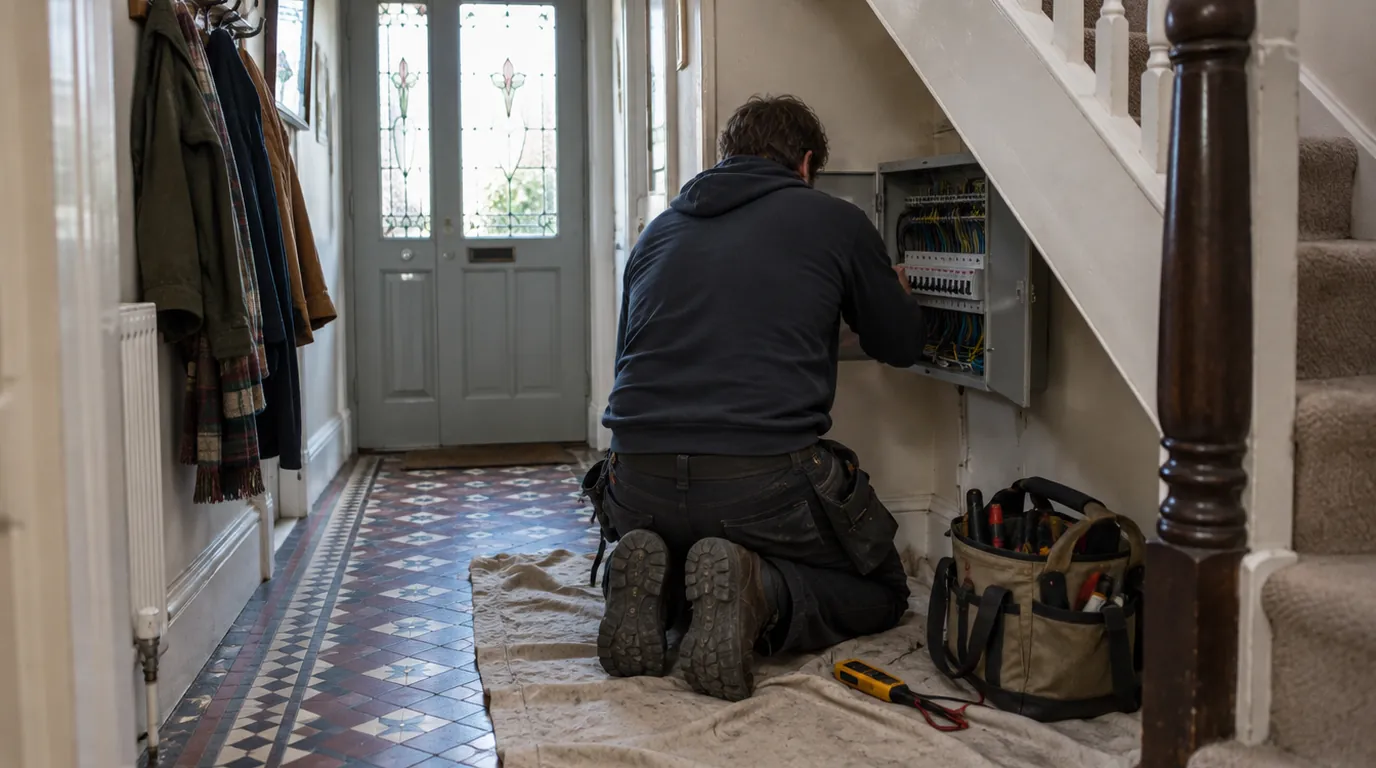
No law makes a UK electrician buy public liability insurance. In practice nearly every working electrician needs it, because the registration schemes you join to sign off your own domestic work, NICEIC, NAPIT and SELECT, all require at least £2 million of public liability cover. Employers’ liability is different: it is the law as soon as you employ someone, with at least £5 million of cover and fines of up to £2,500 for every day without it.
On price, the newest published figure comes from the broker Simply Business: 10% of electricians paid £80.40 or less a year for up to £2 million of public liability cover between April and September 2026. That is the cheap end, not the average. And most of the “from £5 a month” prices you will see are for £1 million of cover, half what the schemes ask for.
This is general information, not advice on which policy to buy.
The key figures
| What | Figure | Source |
|---|---|---|
| Public liability insurance required by law | No | No UK law requires it |
| Public liability needed to register with NICEIC, NAPIT or SELECT, or to join the ECA | At least £2m | Scheme rules; Electrotechnical Assessment Specification, June 2026, clause 12.1 |
| Professional indemnity the schemes require | £250,000, only if you do periodic inspection and testing (EICRs) | Electrotechnical Assessment Specification, clause 12.2 |
| Employers’ liability required by law once you employ anyone | At least £5m | Employers’ Liability (Compulsory Insurance) Regulations 1998, reg. 3 |
| Fine for having no employers’ liability cover | Up to £2,500 a day | 1969 Act, s.5; HSE |
| Fine for not displaying the certificate | Up to £1,000 | HSE; GOV.UK |
| Insurance Premium Tax on the policy | 12% | HMRC, standard rate since 1 June 2017 |
| Public liability price, cheapest 10% of electricians | £80.40 a year or less, cover up to £2m | Simply Business, 1 Apr to 30 Sep 2026 (the firm’s own data) |
| Public liability price, median | £88.30 a year | MoneySupermarket, Simply Business data for policies bought in 2024 |
Do electricians legally need public liability insurance?
No. Insurers that sell it say so plainly: “There is no legal obligation to buy electricians’ public liability insurance,” in Markel’s words. For most electricians the requirement comes through registration instead.
In England and Wales some domestic electrical work is notifiable under Part P of the Building Regulations: a new circuit, a replacement consumer unit, or any addition or alteration to circuits in a special location such as a bathroom. To sign that work off yourself instead of going through building control, you have to be registered with a competent person scheme. The government’s list for electrical work in homes names Certsure (which runs NICEIC), NAPIT, BESCA, Blue Flame Certification and OFTEC.
Every scheme makes insurance a condition of joining and of staying registered. The common rule is in the Electrotechnical Assessment Specification, the industry standard the certification bodies assess you against. Its June 2026 edition says a business “shall be required to hold at least £2 million of public liability insurance covering all Electrotechnical work being assessed or within the scope of its Assessment Certificate”. Assessors ask for evidence of the cover, and at later checks you confirm it is still in place. Drop it and your registration is at risk.
| Body | Public liability | Professional indemnity | Where the rule is |
|---|---|---|---|
| NICEIC Approved Contractor | £2m | £250,000 if periodic inspection and testing is in scope | Scheme Rules AC/RULES/29-07-26, clause 6.1(j) |
| NICEIC Domestic Installer | £2m, “in the registered trading name” | Not stated | Scheme Rules DIS/RULES/29-07-26, clause 6.1 |
| NAPIT | £2m | £250,000 for testing and inspection | NAPIT EAS scheme requirements |
| SELECT (Scotland) | £2m | £250,000 “where appropriate” | SELECT membership criteria |
| ECA (trade association) | £2m | £250,000 if undertaking EICRs | ECA core joining criteria |
Two old names still turn up on insurer pages. ELECSA is no longer a separate scheme: Certsure retired the brand and moved its firms to NICEIC, a switch it said would be complete by November 2022, and elecsa.co.uk now redirects to NICEIC. Stroma has been owned by NAPIT since 2019, and isn’t on the government’s current list of competent person schemes.
Professional indemnity: only if you do EICRs
Some insurer pages say every NICEIC, NAPIT and ECA member needs £250,000 of professional indemnity insurance. The scheme rules say otherwise. The £250,000 applies where your registered scope includes periodic inspection and testing, the condition reports (EICRs) that landlords and buyers ask for. If you only install, the schemes don’t require it, although insurers suggest it if you give design advice.
How much cover do you need: £1m, £2m or £5m?
£2 million is the floor for anyone who is registered. Above that, it depends on who you work for.
- Councils and other public buyers set their own levels for each contract. Under the Procurement Act 2023, in force since 24 February 2025, they can’t require the contract’s insurance to be in place before award, so you don’t pay for cover for work you may not win. Cabinet Office guidance says they can instead ask for evidence that you will have it when the contract starts, such as a letter from an insurer confirming it would offer you the cover plus your commitment to take it out. For scale, Falkirk Council’s 2025 tender for EICRs and repairs asked for £5 million of public liability, £5 million of product liability, £10 million of employers’ liability and NICEIC or SELECT registration. That is one council, not a rule.
- Main contractors set their own terms in the subcontract. No official guidance says what they must ask for, and insurer pages contradict each other on whether a subcontractor is covered by the main contractor’s policy. The subcontract decides, so read it before you start.
- Homeowners rarely ask for a figure, but a registered electrician carries £2 million anyway.
What public liability covers, and what it doesn’t
Public liability pays claims from customers and members of the public who are injured, or whose property is damaged, because of your work, plus the cost of defending the claim. Markel’s example: a customer gets an electric shock from a light switch that was installed wrongly. It does not cover:
- injury to your own staff, which is employers’ liability;
- a customer’s financial loss from your advice, a design or a test report, which is professional indemnity;
- your own tools and van stock, which is tools cover.
What does public liability insurance cost an electrician?
This is where the headline prices mislead. Insurers and brokers advertise a monthly “from” price, and each one measures something different. Most are for £1 million of cover, which isn’t enough to register with any of the schemes above.
| Advertised figure | What it actually measures | Cover behind it | Period |
|---|---|---|---|
| Hiscox: from £5.20 a month | ”an average of all public liability policies sold to at least 10% of our customer base” | Not stated | Aug 2025 to Aug 2026 |
| Markel Direct: from £5 a month | ”an average equivalent monthly of the annual premium” | £1m | Not stated |
| MoneySupermarket: £88.30 a year “average” | The median: “51% of customers paid this amount or less” (Simply Business data) | Not stated | Policies bought in 2024 |
| PolicyBee: from £8.40 a month | Starting price including IPT, for annual income up to £50,000 | £1m | Not stated |
| Protectivity: from £2.89 a month | One real quote, turnover up to £250,000 | £1m | Quote of 19 Aug 2026 |
| Simply Business: £6.70 a month (£80.40 a year) | The 10th percentile: “10% of electricians paid £80.40 or less annually” | Up to £2m (64% of its customers have £1m) | 1 Apr to 30 Sep 2026 |
The firms are listed alphabetically. These are their own figures, not official data, and Paygrade doesn’t recommend any of them. We found no official figures for what tradespeople pay for insurance.
Put together: the cheapest tenth of Simply Business’s electricians paid £80.40 or less this year, and its middle customer paid £88.30 in 2024 (MoneySupermarket’s figure, from the same broker’s data). A firm with staff and higher limits pays far more. Simply Business shows a real quote for a limited company with one employee, £10 million of public and employers’ liability, legal expenses and £15,000 of tools: £1,262.73 a year.
For scale, a year of NICEIC Approved Contractor certification costs £1,190 plus VAT (£1,428 with VAT), so a policy at the median price costs less than a tenth of the registration it is there to satisfy. Against pay, £88.30 is about 0.2% of the £40,717 median for full-time employed electricians in the UK (ONS, 2026), although ONS counts employees, not the self-employed who buy most of these policies. More on that in what electricians earn in the UK.
The excess can swallow a typical claim
Check the excess as well as the price. Simply Business lists public liability excesses from £100 to £2,500, and says its average successful electrician claim from October 2025 to September 2026 was £2,366 (47 claims). Where the excess applies, a £1,000 excess means paying the first 42% of an average claim yourself, and a £2,500 excess covers all of it. Ask which claims the excess applies to.
What the policy really costs after tax
Two things sit inside the price. First, 12% Insurance Premium Tax: on a price that includes it, 12 ÷ 112, or about 10.7% of what you pay, is tax. Second, if you’re self-employed, insurance for the business is an allowable expense, so it comes off your profit before Income Tax and Class 4 National Insurance.
Our worked example, for a sole trader in England, Wales or Northern Ireland in 2026/27 paying a £100 premium:
| Your profit is in the | Tax and NI saved on £100 | What the £100 really costs |
|---|---|---|
| Basic rate band (20% Income Tax plus 6% Class 4) | £26 | £74 |
| Higher rate band (40% Income Tax plus 2% Class 4) | £42 | £58 |
In Scotland the Income Tax bands differ. To see the effect on your own figures, put your profit into the self-employed tax calculator with and without the premium.
When employers’ liability becomes the law
Take someone on, even an apprentice or a mate for a few weeks, and you probably need employers’ liability insurance:
- The amount: at least £5 million, from an authorised insurer. HSE says most insurers offer at least £10 million.
- The fines: up to £2,500 for every day without suitable cover, and up to £1,000 for not displaying the certificate or refusing to show it to an HSE inspector. You can display it electronically.
- Who counts: not their tax status. HSE says what matters is “the real nature of your relationship with the people who work for you and the nature and degree of control that you have over the work they do”. Someone who works when and where you say, with your materials and equipment, and can’t send a substitute, may count as your employee even if they’re self-employed for tax.
- Exemptions: you don’t need it if you only employ close family, but that exemption doesn’t apply to a limited company. A company whose only employee is the owner, holding 50% or more of the shares, is exempt.
- Northern Ireland has its own law with the same £5 million minimum and the same fines, enforced by HSENI.
Before you buy or renew: a checklist
- Check your scheme’s rules for the amount and the name. NICEIC’s Domestic Installer rules want the £2 million “in the registered trading name”.
- Check the cover level behind any price. A price for £1 million isn’t a price for what the schemes need.
- Add £250,000 of professional indemnity if you do EICRs.
- Arrange employers’ liability before anyone starts working for you, and display the certificate.
- Compare the excess, not just the premium.
- For council work, read the tender notice for the levels. You don’t need the cover in place to bid.
- Keep the invoice: the premium is an allowable expense.
New to the trade? The CSCS card guide covers the site card main contractors ask for, the 18th Edition course guide covers the wiring regulations qualification and what it costs, the electrician career profile covers training and progression, and electrician pay in every country compares the UK with 11 others. More UK pay pages, built on official ONS figures, are on the UK hub.
Limits of the data
The prices are insurers’ and brokers’ own figures about their own customers, not a survey of the market, and they define “average” differently; MoneySupermarket’s median uses 2024 data. The scheme rules and legal figures were checked on 5 November 2026 and can change. The tax example assumes a sole trader’s business expense and ignores other reliefs. None of this is insurance advice. How we use sources: methodology.
Sources
- Electrotechnical Assessment Specification, June 2026 edition, clauses 12.1 to 12.3 and 15.5.6 (IET).
- NICEIC (Certsure LLP), Approved Contractor Scheme Rules (AC/RULES/29-07-26), clause 6.1(j); Domestic Installer Scheme Rules (DIS/RULES/29-07-26), clause 6.1; Approved Contractor scheme fees, read 5 November 2026.
- NAPIT, EAS scheme requirements; SELECT, membership criteria; ECA, core joining criteria, all read 5 November 2026.
- Electrical Times, Certsure announces the retirement of the ELECSA brand, 3 February 2021; Professional Electrician on NAPIT’s acquisition of Stroma, 19 December 2019.
- Ministry of Housing, Communities and Local Government, Competent person scheme: current schemes, updated 17 September 2026; Approved Document P, 2013 edition (England).
- Employers’ Liability (Compulsory Insurance) Act 1969, sections 1, 2 and 5; Employers’ Liability (Compulsory Insurance) Regulations 1998, regulations 3 and 5.
- Health and Safety Executive, HSE40: Employers’ Liability (Compulsory Insurance) Act 1969, a brief guide for employers; GOV.UK, Employers’ liability insurance; nibusinessinfo.co.uk, Employers’ liability insurance (Northern Ireland).
- Procurement Act 2023, section 22; Cabinet Office, Guidance: Conditions of Participation, paragraphs 18 to 20, updated 17 August 2026; Falkirk Council, Electrical Installation Condition Reports (EICR) and Repairs, Find a Tender, 10 October 2025.
- HM Revenue and Customs, Insurance Premium Tax rates; GOV.UK, Expenses if you’re self-employed. Income Tax and Class 4 rates for 2026/27 as used in our self-employed tax calculator.
- Provider figures, all read 5 November 2026: Simply Business (page updated 28 October 2026); MoneySupermarket (reviewed 3 November 2026); Markel Direct; PolicyBee; Protectivity; Hiscox.
- Office for National Statistics, Annual Survey of Hours and Earnings 2026 provisional, Table 14.7a, SOC 2020 5241, median gross annual pay of full-time employees.