
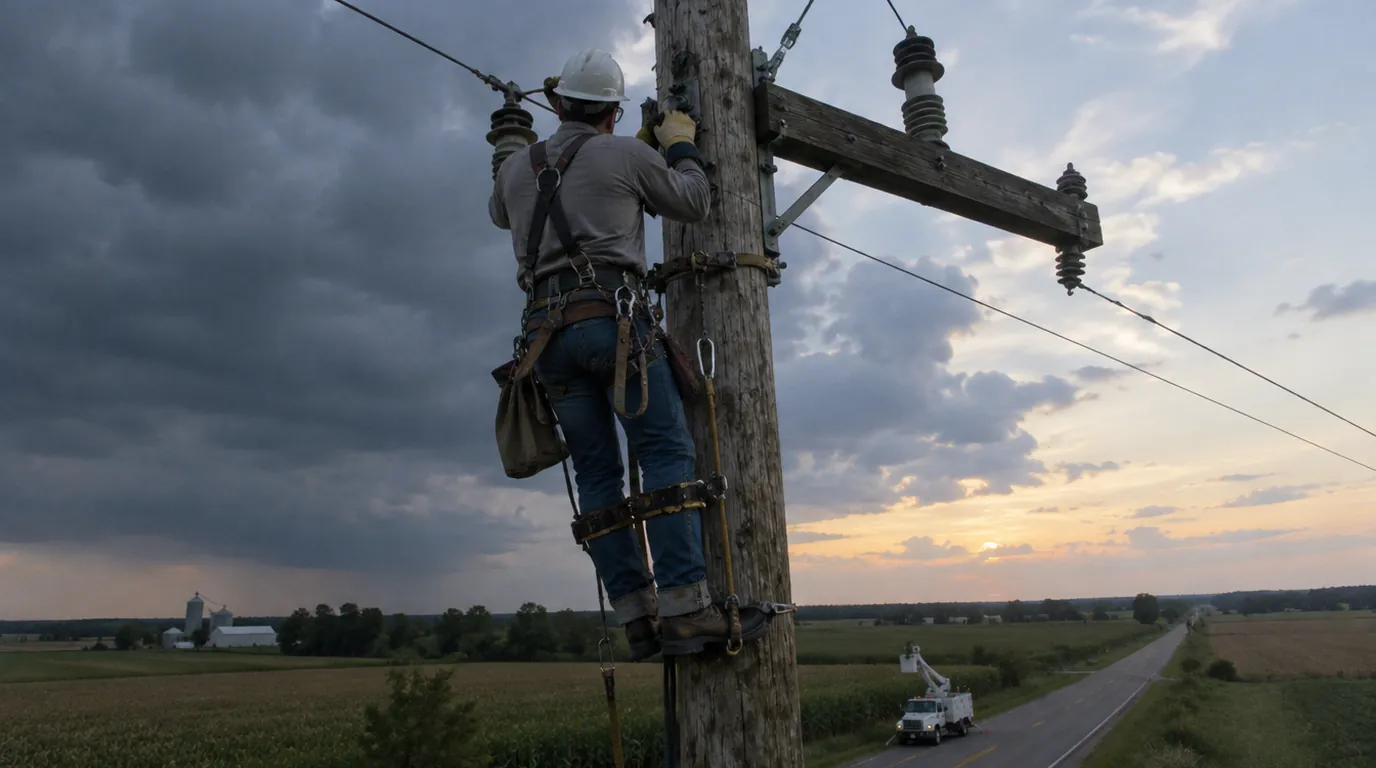
Electrical power-line installers and repairers, the job most people mean by “lineman”, earned a median of $95,320 a year ($45.83 an hour) in May 2025, according to the Bureau of Labor Statistics. The top 10% earned more than $128,690 and the bottom 10% less than $51,470. Those figures leave out overtime, which BLS doesn’t count, and overtime is where storm work pays. Union journeymen on the California outside line agreement earn $74.43 an hour from 1 June 2026, about $154,800 for a 40-hour year before a single overtime hour.
The key figures
| Figure | Value | Source |
|---|---|---|
| Median pay, electrical power-line installers and repairers | $95,320 a year ($45.83 an hour) | BLS OEWS, May 2025 |
| Middle half earn | $67,270 to $109,740 | BLS OEWS, May 2025 |
| Top 10% earn more than | $128,690 | BLS OEWS, May 2025 |
| People in the job | 131,070 | BLS OEWS, May 2025 |
| Telecommunications line installers, median | $74,330 | BLS OEWS, May 2025 |
| Electricians, median (for comparison) | $63,190 | BLS OEWS, May 2025 |
| Union journeyman lineman, California, from 1 June 2026 | $74.43 an hour, plus $14.33 into the NEAP retirement plan | California Outside Line Construction Agreement 2022 to 2027 |
| First-period apprentice, same agreement | $44.66 an hour (60% of journeyman) | Same agreement |
| Projected job growth, power-line installers | 10% from 2025 to 2035, about 10,900 openings a year | BLS Occupational Outlook Handbook |
Why the official figure understates what linemen earn
BLS pay figures are “straight-time, gross pay, exclusive of premium pay”, and its list of exclusions starts with the one that matters here: overtime pay. Shift differentials, on-call pay and meal and lodging payments are left out too.
For most jobs that’s a small gap. For lineworkers it’s a big one. BLS itself notes that after storms and other disasters, line crews may travel to the damage and work long hours for several days in a row. The $95,320 median is a fair picture of base pay. It is not a picture of a year with two hurricanes in it.
Lineman salary by state
Pay depends heavily on where you work. The West Coast pays the most, and the states with the most linemen pay well below the national median.
| Highest-paying states | Median pay | Hourly | Linemen employed |
|---|---|---|---|
| Hawaii | $134,340 | $64.59 | 600 |
| Washington | $133,060 | $63.97 | 2,340 |
| Oregon | $131,090 | $63.02 | 1,640 |
| California | $129,040 | $62.04 | 8,930 |
| Connecticut | $126,850 | $60.99 | 940 |
| Idaho | $125,410 | $60.29 | 860 |
| New Jersey | $121,580 | $58.45 | 1,310 |
| New York | $121,280 | $58.31 | 5,840 |
| Montana | $110,320 | $53.04 | 680 |
| Massachusetts | $110,210 | $52.99 | 2,350 |
| States with the most linemen | Median pay | Linemen employed |
|---|---|---|
| Texas | $78,940 | 17,280 |
| California | $129,040 | 8,930 |
| Florida | $86,870 | 6,420 |
| New York | $121,280 | 5,840 |
| North Carolina | $77,270 | 5,650 |
Texas employs almost twice as many linemen as any other state, but its median is 17% below the national figure. The lowest medians are in Arizona ($75,420), Mississippi ($75,890) and Oklahoma ($76,010). The top of the table is mostly the West and the Northeast; the bottom is mostly the South and Southwest.
What a union journeyman lineman earns
The clearest view of real lineman pay is in the contracts themselves. The California Outside Line Construction Agreement, between the Western Line Constructors Chapter of NECA and IBEW Locals 47 and 1245, runs from 1 June 2022 to 31 May 2027 and sets these hourly rates:
| Classification | From 1 June 2025 | From 1 June 2026 |
|---|---|---|
| General foreman | $86.72 | $89.32 |
| Foreman | $79.44 | $81.82 |
| Journeyman lineman | $72.26 | $74.43 |
| Line equipment man | $54.50 | $55.59 |
| Groundman | $41.68 | $42.51 |
On top of the wage, the agreement sets $14.33 an hour for a journeyman into the NEAP retirement plan from June 2026, and a flat $50 a day subsistence for each day worked.
Utility linemen are on separate contracts, but the levels line up. The Eugene/Springfield Utilities apprenticeship in Oregon reported an average journey-level wage of $65.52 an hour on 1 October 2025, close to the BLS Oregon median of $63.02.
Storm work: how the overtime adds up
Under the California agreement, a normal day is 8 hours between 7:00 a.m. and 4:30 p.m., Monday to Friday. Everything outside those hours, plus Saturdays, Sundays and holidays, is paid at double the straight-time rate, which is also the cap. On storm damage the employer covers meals and lodging after 16 hours.
Here’s what that means for a journeyman at the June 2026 rate of $74.43:
| Week | Hours | Gross pay |
|---|---|---|
| Normal week | 40 hours, Monday to Friday | $2,977.20 |
| Storm week, 16-hour days, 7 days | 40 straight-time hours, 72 double-time hours | $13,695.12 |
The storm week works out as 5 days of 8 hours at $74.43 plus 8 hours at $148.86 ($1,786.32 a day), plus two 16-hour weekend days at $148.86 ($2,381.76 each). That’s 4.6 times a normal week, before the $50 daily subsistence. It’s an illustration of the rules, not a typical week: storm terms differ by local and employer, and nobody works 112-hour weeks all year.
It’s also why “linemen make $200,000” claims aren’t all hype. A California journeyman earns about $154,800 at 40 hours a year. Another $45,200 takes roughly 300 double-time hours, about 6 a week. At the national median of $45.83 an hour, the same $200,000 would need more than 1,100 double-time hours.
Apprentice lineman pay
Linemen learn on the job, usually through a registered apprenticeship run by a joint union and employer committee (a JATC) or a utility. You’re paid from day one, as a percentage of the journeyman rate:
| Apprenticeship | Length | Pay steps |
|---|---|---|
| California outside line (IBEW 47 and 1245) | 7,000 hours plus 144 classroom hours a year | 60%, 65%, 70%, 75%, 80%, 85%, 90% |
| Okanogan County Electric, Washington | 7,000 hours | Starts at 65%, up 5 points every 1,000 hours |
| Eugene/Springfield Utilities JATC, Oregon | 6,000 hours | 70%, 73%, 76%, 80%, 84%, 90% |
In California that means $44.66 an hour in the first period from June 2026, rising to $66.99 in the seventh. At 40 hours a week, a first-period apprentice there earns about $92,900 a year, close to the national median for fully qualified linemen. BLS says apprentices typically reach journey level after 3 or 4 years.
Do you need lineman school?
It isn’t required: BLS lists a high school diploma as the typical entry-level education. Lineman schools sell a head start: climbing, rigging and a commercial driver’s license, which some apprenticeships, such as the Northwest Line Construction JATC’s, require you to hold.
The cost is real. At Northwest Lineman College, the 15-week, 480-hour program starting in its 2026 first term costs $23,548 at the Idaho campus and $25,923.38 in California, including the required tools. The college doesn’t take federal student aid (FAFSA); it accepts private loans and other funding. At California’s first-period apprentice rate, that’s about 13 weeks of pay to earn back, if the course gets you into an apprenticeship faster.
What linemen take home
Gross pay is only half the story. Here’s what a single person keeps on the median in the biggest lineman states, after federal and state income tax, Social Security, Medicare and state payroll contributions (2026 rules, standard deduction, no other income):
| Where | Gross (median) | Take-home | Per month |
|---|---|---|---|
| Texas | $78,940 | $64,364 | $5,364 |
| Florida | $86,870 | $69,943 | $5,829 |
| New York | $121,280 | $87,437 | $7,286 |
| California | $129,040 | $90,176 | $7,515 |
| Oregon | $131,090 | $89,511 | $7,459 |
| Washington | $133,060 | $100,367 | $8,364 |
| California union journeyman, 40-hour year | $154,814 | $105,060 | $8,755 |
Washington and California pay linemen about the same before tax, but a Washington lineman keeps about $10,200 a year more, because the state has no income tax. Union dues and pension contributions come off on top of these figures. To see what your own rate leaves in each paycheck, in any state, use our free paycheck calculator.
How lineworker pay compares
At $95,320, the median lineworker earns 51% more than the median electrician ($63,190) and almost twice the median for all US jobs ($50,980). Telecommunications line installers, who work on phone and cable lines rather than power, earn a median of $74,330. It’s one of the best-paid jobs you can get without a degree, which is why it sits near the top of our list of the highest-paying jobs without a degree, and why it belongs among the highest-paying jobs nobody wants: the money comes with heights, high voltage and nights away in bad weather.
If you’re choosing between the two trades, compare our electrician salary in the United States page, with BLS pay by state, and the electrician career profile. For linemen in Texas, the Texas pay page shows how the state’s wages compare overall, and the salary comparison by city tool shows what a move from Houston to Seattle would really be worth once prices are counted. Already in the trade? Check your rate with Am I underpaid?.
Limits of these figures
- BLS excludes overtime, so every BLS figure here is base pay. Storm-heavy years can add a lot.
- Union rates are one agreement. The California rates show what a strong union region pays; other locals and utilities pay less, and non-union contractors set their own rates.
- The storm week is an illustration of one agreement’s rules, not an average week.
- Take-home is for a single filer with no other income, before union dues, pension contributions or local taxes. More on how we handle official data in our methodology.
FAQ
How long does it take to become a journeyman lineman? The apprenticeships we checked run 6,000 to 7,000 hours of paid work, about 3 to 4 years. BLS says apprentices typically reach journey level after 3 or 4 years.
Do linemen get paid more for storm work? Under the California agreement, yes, through overtime rather than a separate storm rate: hours outside the normal 8-hour weekday and all weekend hours are paid at double time, and the employer covers meals and lodging on storm damage after 16 hours.
Sources
- Bureau of Labor Statistics, Occupational Employment and Wage Statistics, May 2025: national and state data for electrical power-line installers and repairers (49-9051), telecommunications line installers and repairers (49-9052), electricians (47-2111) and all occupations. Medians and percentiles of annual pay, published 2026.
- Bureau of Labor Statistics, OEWS frequently asked questions (definition of wages and the list of exclusions, including overtime).
- Bureau of Labor Statistics, Occupational Outlook Handbook: Line Installers and Repairers (projections 2025 to 2035, time to journey level, storm work).
- Western Line Constructors Chapter of NECA and IBEW Locals 47 and 1245, California Outside Line Construction Agreement, 1 June 2022 to 31 May 2027: Exhibit A wage rates, sections 4.1 and 4.10 (hours and double time), storm damage meals and lodging, section 5.2 (subsistence), apprentice footnote (7,000 hours, 144 classroom hours a year).
- Oregon Bureau of Labor and Industries, Eugene/Springfield Utilities JATC Electrical Lineman standards, Appendix E (average journey wage on 1 October 2025, wage progression).
- Washington State Apprenticeship and Training Council, Northwest Line Construction Industry JATC standards revision (7,000-hour term, commercial driver’s license requirement).
- Washington State Apprenticeship and Training Council, Okanogan County Electric lineman standards (7,000-hour term, wage progression).
- Northwest Lineman College, 2025-26 Electrical Lineworker Program catalog, volume 2 (2026 term 1 costs, program length, funding).
- Take-home pay: Paygrade’s US tax engine (IRS 2026 brackets and standard deduction, Social Security and Medicare, 2026 state income tax and payroll contribution rules), checked against hand-worked examples.